
Fuel Polishing Systems

Fuel Polishing Systems: Why Stored Diesel Needs One
A fuel polishing system removes water, sediment, and microbial contamination from diesel fuel that’s sitting in storage — which matters more today than it used to, because modern ultra-low sulfur diesel doesn’t hold up in storage the way older diesel formulations did. If your facility depends on a standby generator that might not run for months at a stretch, the fuel sitting in that tank is quietly degrading the entire time.
This post covers what fuel polishing actually does, why static fuel storage is a bigger problem than most people realize, and two different ways to approach it.
Why Stored Diesel Fuel Degrades
When a standby generator fails to start during a utility outage, the post-incident investigation almost always turns up the same category of culprit: fuel. Sometimes it’s contamination that arrived with a delivery. More often, it’s fuel that degraded quietly while it sat.
Modern ultra-low sulfur diesel is chemically less stable than the fuel it replaced. A tank that sits untouched between annual load tests is an incubator for the kind of contamination — water, particulates, and microbial growth — that clogs injectors and damages injection pumps at the worst possible moment. Bad fuel doesn’t arrive in a generator on its own; it gets there through whatever delivery system is between the tank and the engine.
What a Fuel Polishing System Actually Does
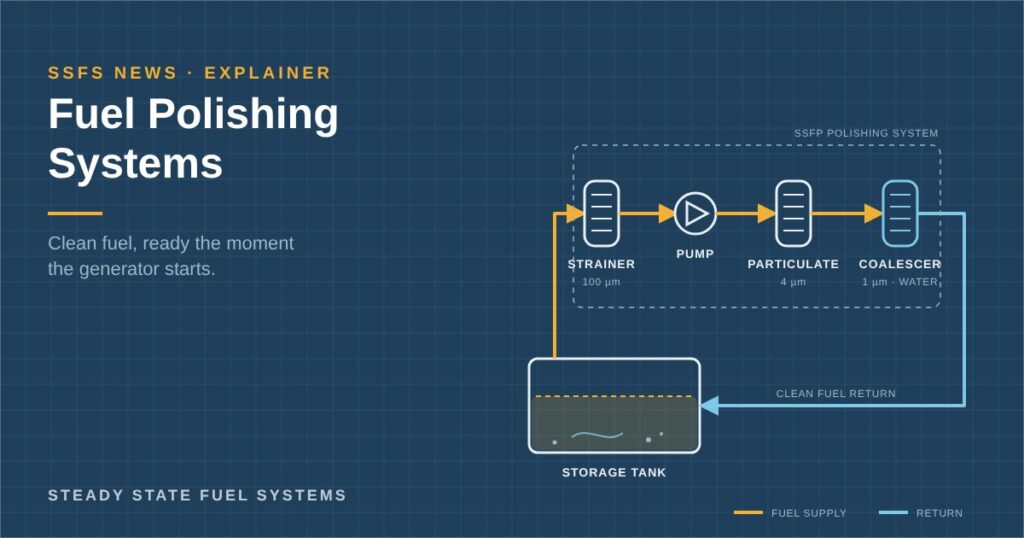
A fuel polishing system pulls fuel out of storage, passes it through filtration stages designed to remove both particulate contamination and free water, and returns clean fuel to the tank. A typical two-stage design pairs a particulate filter with a water-absorbing element, and cleanliness is often specified against the ISO 4406 standard, which rates fuel by particle count per unit volume.
Done regularly, fuel polishing keeps stored diesel usable indefinitely, rather than letting it degrade toward the point where it becomes a liability the moment the generator actually needs to run.
The Traditional Approach: A Bolt-On Polishing Skid
Historically, the industry’s answer to fuel degradation has been to add a standalone fuel polishing system alongside an already-complex day tank installation — another skid, another control panel, another item on the maintenance schedule. It works, but it’s an addition, not a redesign. The polishing system runs on its own schedule, separate from the delivery system that actually feeds the generator, and it’s one more thing that has to be remembered, serviced, and paid for.
A Different Approach: Polishing Built Into the Delivery System
There’s a case for rethinking the architecture instead of bolting on another box. Steady State Fuel Systems builds fuel polishing directly into a dual-loop fuel conditioning and delivery system, rather than treating it as a separate add-on.
Here’s how that works in practice. A continuous bulk recirculation loop draws fuel from storage, routes it through a two-stage filter bank and a crossflow heat exchanger, and returns it to bulk storage — running the entire time the generator runs, with no separate schedule to manage. Because filtration happens as part of normal delivery instead of as a bolt-on service, fuel does not sit and stagnate between events, and microbial growth has far less opportunity to establish.
A 25 psid internal filter bypass keeps fuel flowing even if a filter element is fully restricted, so polishing capacity never becomes a single point of failure in the fuel path. And because the reservoir that ultimately feeds the generator is small and continuously replenished from the recirculation loop, the fuel reaching the generator reflects the improving quality of the bulk supply — progressively, not on a fixed service interval.
Choosing Between Standalone Polishing and an Integrated System
Both approaches solve the same underlying problem — stored diesel degrades, and something needs to keep it clean. The right choice depends on what’s already installed:
- Retrofitting an existing tank with no polishing at all? A standalone fuel polishing system, serviced on a regular schedule, is a reasonable and well-understood starting point.
- Designing a new installation, or replacing an aging day tank system? Building continuous polishing into the delivery architecture removes a maintenance item entirely, rather than adding one.
If you’re not sure which situation you’re in, talk to us — we work with both retrofit and new-build projects and can walk through what makes sense for your site.
Fuel Polishing System FAQ
How often should diesel fuel be polished? It depends on tank turnover, local climate, and how long fuel sits between deliveries — but for standby generator applications where fuel can sit for months between load tests, an annual or semiannual polishing cycle is a common baseline for standalone systems. A continuously recirculating design removes the question by keeping fuel in motion the entire time the generator runs.
Does fuel polishing remove water from diesel? Yes — free water removal is one of the primary jobs of a fuel polishing system, typically handled by a water-absorbing filter stage alongside particulate filtration.
Is fuel polishing the same thing as a day tank? No. A day tank stores fuel close to the generator; fuel polishing conditions the fuel itself. Some designs keep them entirely separate; others, like a dual-loop fuel conditioning system, combine both functions in one architecture.
What standard governs fuel cleanliness? ISO 4406 is the standard most commonly referenced for hydraulic and fuel cleanliness ratings by particle count. Storage and handling requirements for the fuel itself are typically governed by NFPA 30 and related codes — see NFPA’s standards library for the edition adopted in your jurisdiction.