
Generator Day Tank Systems Explained

Generator Day Tank Systems Explained: A Buyer’s Guide
If your facility runs an emergency or standby generator, there’s a good chance a generator day tank sits somewhere in that fuel path — and there’s a good chance nobody thinks about it until it doesn’t work. That’s the nature of standby equipment. It waits. Then, during a utility outage, it’s asked to perform flawlessly on the first try.
This guide covers what a day tank actually does, how a typical system is built, where these systems tend to fail, and what to look for whether you’re specifying a new installation or maintaining an existing one.
What a Generator Day Tank Does
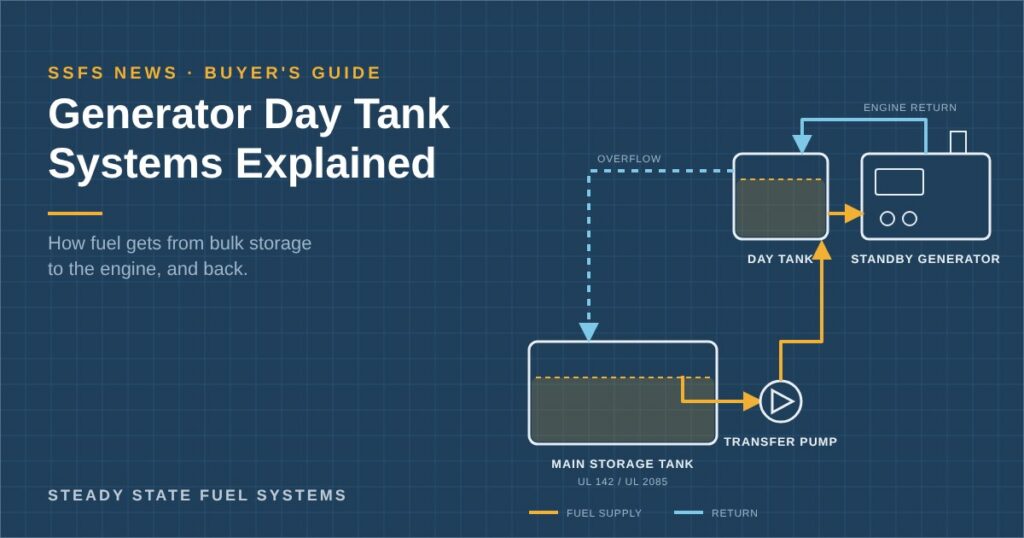
The concept is simple. A generator day tank holds a small fuel reserve close to the generator, so the engine’s integral fuel pump always has a nearby source to draw from — instead of pulling fuel from a remote bulk storage tank on a long suction run.
Done well, this is sound engineering. A properly sized day tank shortens the suction lift, buffers against a slow bulk transfer response, and keeps a known quantity of fuel local to the load. For decades, that was the whole story.
How a Modern Day Tank System Is Built
In practice, today’s generator day tank installations have grown considerably more involved than the original concept. A typical system now includes:
- A transfer pump (often duplex, for redundancy) that moves fuel from bulk storage into the day tank
- Float switches or electronic level sensors that tell the pump when to start and stop
- A solenoid fill valve
- High-level and low-level alarms
- Overflow return piping, to send excess fuel back to bulk storage
- A control panel to sequence all of the above
- In many buildings, exterior vent piping to relieve vapor pressure during fill and drain cycles
Each component solves a real problem. Duplex pumps address single-pump failure risk. Level switches replace manual inspection. However, every one of these parts is also a potential failure point — a float that sticks, a solenoid that fails open or closed, a level switch that drifts out of calibration.
Where Day Tank Systems Actually Fail
The most overlooked issue in day tank design isn’t the component count — it’s the operating behavior. A day tank system is constantly changing state. The transfer pump cycles on and off. Float switches open and close. Level switches trigger alarms and control signals.
During an extended outage, those components can cycle dozens or hundreds of times, and every cycle is a chance for something to go wrong. A generator day tank that has sat dormant for months, then asked to run flawlessly through hundreds of fill cycles, is exactly the situation where a stuck float switch or a solenoid that won’t reseat becomes a real problem — usually discovered at the worst possible moment.
Fuel quality compounds this. Modern ultra-low sulfur diesel degrades faster than the fuel it replaced and supports microbial growth more readily. A day tank sitting partially full for months at ambient temperature accelerates that degradation, which is why many facilities end up bolting on a separate fuel polishing system just to keep tank contents usable.
What to Look for in a Generator Day Tank Design
Whether you’re specifying new equipment or evaluating what’s already installed, a few design choices make a measurable difference in reliability:
Lead/lag pump control with proof-of-flow detection. Relying on a motor’s internal contacts to confirm a pump is actually moving fuel is weaker than confirming flow directly — a flow switch on a common manifold catches a pump that’s drawing current but not delivering fuel.
A steel enclosure rated for the environment. A NEMA 4 control panel holds up in a mechanical room or an exterior generator yard where a lighter enclosure won’t.
Clear fault indication. Both critical-high and critical-low conditions should trigger a visible fault indicator, not just a silent alarm buried in a BMS point list — someone doing rounds needs to be able to see, at a glance, that the system needs attention.
Manual override at the panel. An operator should be able to select Motor 1, Motor 2, or automatic alternation directly, without needing a laptop or a service call.
Steady State Fuel Systems builds a relay-logic generator day tank control system around exactly these principles — a defensible, code-compliant design rather than the least expensive option on the market. For facilities that want to remove day tank cycling from the equation entirely, our dual-loop fuel conditioning system replaces the day tank altogether with a continuously recirculating architecture that has a single operating state: on.
Generator Day Tank FAQ
How big should a generator day tank be? Sizing depends on the generator’s fuel consumption rate and the runtime required by code and by the facility’s own emergency power plan. NFPA 110 governs sizing and design requirements for emergency power supply systems — see NFPA’s standards library for the current edition adopted in your jurisdiction.
Does a day tank need an exterior vent? Most conventional fill-and-drain day tank designs do, to relieve vapor pressure as the tank fills and drains. That requirement is one of the main reasons some facilities look at alternative architectures that avoid repeated fill/drain cycling.
What’s the difference between a day tank and fuel polishing? A day tank stores fuel close to the generator. Fuel polishing removes water, sediment, and microbial contamination from stored fuel. They solve different problems — read more in our guide to fuel polishing systems.
If you’re planning a new standby generator installation, or troubleshooting recurring faults on an existing day tank, get in touch — we’re happy to talk through what fits your site.