
Remote Fill Systems explained

Remote Fill Systems for Diesel Tanks: How Overfill Prevention Works
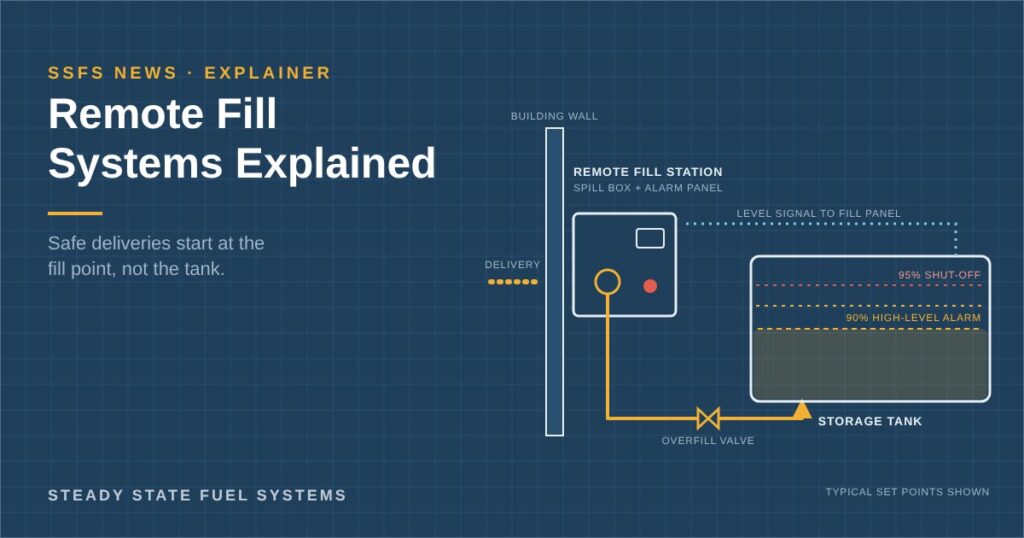
A remote fill system lets a fuel delivery driver refuel a diesel tank from a fill point that’s easy and safe to reach — rather than requiring access to the tank itself, which is often buried, enclosed, or simply inconvenient to get a hose to. Done right, the fill point is also where overfill prevention lives, so a routine delivery can’t turn into a spill.
This post walks through what a remote fill system needs to do, the level-switch logic that makes overfill prevention actually reliable, and a few design decisions that are easy to get wrong.
Why a Remote Fill System Matters
Most diesel storage tanks for emergency generators are sized to hold a significant volume of fuel, and refueling happens with a tank truck under time pressure. If the fill point is hard to access, a driver is more likely to rush the process — and rushing near a tank that’s approaching capacity is exactly when overfills happen.
A properly designed remote fill system solves two problems at once. It puts the fill connection somewhere a truck can reach easily, and it puts automatic protection between “the driver stopped watching the gauge” and “fuel on the ground.”
How Overfill Prevention Logic Actually Works
The core of a good remote fill system is a pair of level switches set at two different points in the tank, each doing a different job.
The first switch (typically around 90% capacity) sounds an alarm at the fill panel and energizes a relay to prevent further filling. This is designed to be operator-overridable — if the crew confirms it’s a false trip or a planned near-capacity fill, they can continue.
The second switch (typically around 95% capacity) also alarms and closes the solenoid, but this one is not overridable until the level actually drops. It’s the last line of defense, and it’s built to stay locked out — usually requiring a manual reset — rather than auto-clearing the moment the level dips slightly, which prevents the system from chattering open and closed right at the setpoint.
Both switches are normally closed with de-energize-to-trip logic, meaning a wiring fault or power loss trips the system into its safe state rather than silently failing open. The fill solenoid itself should be normally closed and energize-to-open, so it fails closed — not energized — if power is lost.
Why the Fill Sequence Matters as Much as the Switches
A remote fill system that’s well-designed on paper can still create nuisance problems if the sequence of operation isn’t thought through. A few details worth getting right:
Don’t energize the solenoid continuously at standby. Instead, give the operator a momentary START pushbutton at the fill panel that energizes the solenoid through a seal-in relay circuit only when a fill is actually happening. This keeps the valve de-energized — and therefore closed — any time nobody has actively initiated a fill.
Position the non-overridable switch upstream of the override. The 90% override should be a deliberate operator action; the 95% cutoff should not be something an override circuit can accidentally bypass.
Add a time delay at each setpoint. Level switches near a setpoint can chatter as fuel sloshes during filling. A short time delay prevents the alarm and solenoid from cycling rapidly right at the trip point.
Document the sequence of operation formally. A written sequence of operation and a relay ladder logic diagram make the system’s behavior verifiable during commissioning — and make troubleshooting far faster months or years later when someone unfamiliar with the original design has to service it.
Steady State Fuel Systems designs remote fill systems around this exact logic — de-energize-to-trip level switches, a fail-closed solenoid, an overridable warning stage and a non-overridable safety stage, and a complete submittal package with ladder logic and sequence of operation documentation. If your fill system is a bare fill cap with no overfill protection, or an older design you’re not confident in, we can help you evaluate it.
Remote Fill System FAQ
Is overfill prevention required by code? Requirements vary by jurisdiction and tank type, but overfill prevention is a common requirement for aboveground and underground storage tanks under NFPA 30 and related fire and life-safety codes. Check the specific edition adopted in your jurisdiction — NFPA’s code library is the primary reference.
What happens if the solenoid loses power during a fill? With a normally closed, energize-to-open solenoid, a loss of power closes the valve automatically. This fail-closed behavior is a deliberate design choice, not an incidental feature — a fill system should default to the safe state on any power interruption.
Can one remote fill system serve multiple tanks? It depends on the site layout and code requirements for each tank. This is worth reviewing with a designer before assuming a single fill point can serve more than one storage vessel.
How does a remote fill system relate to a day tank or a fuel conditioning system? They’re different parts of the same fuel path. A remote fill system gets fuel into bulk storage safely; from there, a day tank or a continuously recirculating fuel conditioning system delivers it to the generator.